

Call us now
08045800138

 Send Inquiry
Jacketed Coil Condensers
MOQ : 10 Pieces
Jacketed Coil Condensers Trade Information
- Minimum Order Quantity
- 10 Pieces
- Payment Terms
- Cash in Advance (CID), Cash Advance (CA)
- Supply Ability
- 500 Pieces Per Day
- Delivery Time
- 1 Week
- Packaging Details
- Carton Box
- Main Export Market(s)
- Asia, Middle East, Eastern Europe, South America, Western Europe, Central America, North America, Australia, Africa
- Main Domestic Market
- All India
About Jacketed Coil Condensers
Cylindrical Dropping Funnels are laboratory apparatus used for controlled and precise dispensing of liquids. They consist of a cylindrical glass tube with a tapered tip at the bottom, allowing for controlled release of the liquid drop by drop.
Frequently Asked Questions :
Q: What is the purpose of a Cylindrical Dropping Funnel?
A: Cylindrical Dropping Funnels are used in laboratory settings to add liquids to a reaction mixture or to carry out titrations. Their precise design enables controlled and gradual dispensing of the liquid, ensuring accuracy and reproducibility in experimental procedures.
Q: How are Cylindrical Dropping Funnels different from regular funnels?
A: Unlike regular funnels that have a wide opening for rapid pouring, Cylindrical Dropping Funnels have a narrow, tapered tip that allows for precise control over the liquid flow. This design feature enables the dispensing of small, measured volumes of liquid, drop by drop.
Q: What types of liquids can be used with Cylindrical Dropping Funnels?
A: Cylindrical Dropping Funnels can be used with a wide range of liquids, including aqueous solutions, organic solvents, acids, bases, and other liquid reagents commonly used in laboratory experiments. However, it is important to consider the compatibility of the liquid with the funnel material to avoid any chemical reactions or contamination.
Q: How do you use a Cylindrical Dropping Funnel?
A: To use a Cylindrical Dropping Funnel, the liquid is poured into the funnel from the top. The flow of the liquid is controlled by adjusting the stopcock or the valve mechanism attached to the funnel. By turning the stopcock, the liquid can be dispensed drop by drop, allowing for precise addition to the reaction vessel.
Q: What are the benefits of using Cylindrical Dropping Funnels?
A: Cylindrical Dropping Funnels provide several advantages in laboratory work. They allow for precise control over the addition of liquids, ensuring accuracy and reproducibility in experiments. They are particularly useful in procedures requiring small volumes or when slow addition is necessary to prevent sudden reactions or overflow.
Engineered for Superior Efficiency
Our Jacketed Coil Condensers utilize advanced glass coil technology, ensuring efficient condensation for laboratory processes. The double-layered jacket design supports rapid cooling and improved thermal transfer, making them suitable for demanding scientific applications.
Durability You Can Rely On
Crafted from robust, high-grade transparent glass, these condensers offer a prolonged operational lifespan. Their rugged construction minimizes wear and tear, providing dependable performance in laboratory environments and reducing the need for frequent replacements.
Versatile Laboratory Applications
With sizes ranging from 150 to 500 mm, these condensers meet a variety of laboratory requirements. Whether used in distillation, reflux, or other condensation processes, they are adaptable to diverse setups, increasing their versatility across scientific fields.
FAQs of Jacketed Coil Condensers:
Q: How does a Jacketed Coil Condenser improve laboratory efficiency?
A: The condensers jacketed coil design provides an enlarged surface area for heat exchange, allowing faster and more effective condensation of vapors. This boosts process efficiency and shortens experiment times.Q: What materials are used in the construction of these coil condensers?
A: Our jacketed coil condensers are made from high-quality, transparent glass. This material ensures chemical resistance, clarity for observation, and durability for long-term laboratory use.Q: When should I use a jacketed coil condenser in the laboratory?
A: These condensers are best used during experiments requiring efficient vapor condensation, such as distillation or reflux processes. They are especially beneficial when improved cooling or precise thermal control is needed.Q: Where are these condensers exported and manufactured?
A: We manufacture and export these high-quality glass condensers from India, serving laboratories and scientific institutions both domestically and internationally.Q: What is the operating process for a jacketed coil condenser?
A: To operate, cooling fluid circulates through the outer glass jacket while vapor passes through the coil inside. The cool jacket rapidly condenses vapors, facilitating efficient separation or reflux in laboratory setups.Q: What are the key benefits of using a glass jacketed coil condenser?
A: The key advantages include a long working life due to durable glass construction, enhanced condensation efficiency, chemical resistance, easy maintenance, and suitability for a wide range of laboratory processes.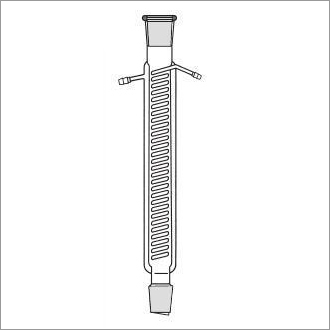
Tell us about your requirement

Price:
Quantity
Select Unit
- 50
- 100
- 200
- 250
- 500
- 1000+
Additional detail
Mobile number
Email

More Products in Glassware Instruments Category
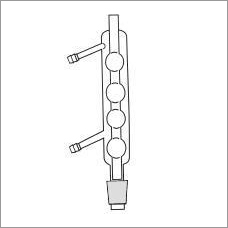
Allihn Condensers Bulb Condenser
Price Range 250.00 - 1200.00 INR / Piece
Minimum Order Quantity : 10 Pieces
Usage : In Laboratory
Color : Transparent
Material : Borosilicate Glass
Feature : Long Working Life
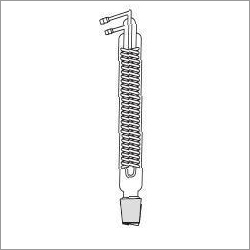
Borosilicate Glass Friedrichs Condenser
Price Range 52.00 - 380.00 INR / Piece
Minimum Order Quantity : 10 Pieces
Usage : In Laboratory
Color : Transparent
Material : Glass
Feature : Long Working Life
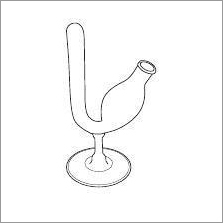
Graduated Fermentation Tube
Price Range 100.00 - 480.00 INR / Piece
Minimum Order Quantity : 10 Pieces
Usage : For Laboratory
Color : Transparent
Material : Borosilicate Glass
Feature : Long Working Life and Better Efficiency
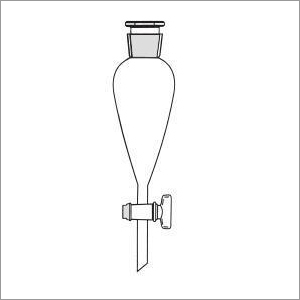
Chemical Laboratory Separating Funnels
Price Range 50.00 - 390.00 INR / Piece
Minimum Order Quantity : 10 Pieces
Usage : For Laboratory
Color : Transparent
Material : Glass
Feature : Better Efficiency

SADANA BROTHERS
SCI-LAB SOLUTION
SCI-LAB SOLUTION
Plot No- A-8/1, Naraina Ind. Area, Phase 1, New Delhi - 110028, India
Phone :08045800138
 Send Inquiry
 Send Inquiry
 Send SMS
SADANA BROTHERS
All Rights Reserved.(Terms of Use)
Developed and Managed by Infocom Network Private Limited.
Developed and Managed by Infocom Network Private Limited.

